The Social Ecology of Population and Place Lab (SEPP)
Social Demography • Field Epidemiology • Social Determinants of Health
About the Lab
The Social Ecology of Population and Place is an integrative framework that examines how human groups and their surrounding environments shape one another over time. Drawing from sociology, demography, and public health, it shifts focus away from individual behaviors to investigate how demographic trends such as aging, population density, and household size interact with spatial contexts and social conditions of where they live. This framework bridges geographic context and group-level human dynamics, exploring two reciprocal questions:
- How does place shape population? (How do local physical, economic, and social environments influence demographic trends, community health, and disease risk?)
- How does population shape place? (How do shifting population dynamics transform the built infrastructure, social cohesion, and natural resources of a community?
The SEPP Lab investigates the social determinants and fundamental causes of health and disease across geographic scales. Integrating quantitative social demography with field epidemiology, the lab combines macro-level population data architectures and spatial analytics with ground-level, mixed-methods field studies. Our research spans rural communities in the upper Midwest to international field sites, with primary field activities in Iowa and Eastern Uganda. We model how spatial context, social structure, population dynamics, and cultural factors, such as attitudes, beliefs, customs, and practices, interact to shape disease risk and transmission.
Research Projects
The lab has two active research projects and a third in development. The first project focuses on the determinants of malaria prevention knowledge and practices, using survey data and field observations to understand the social, cultural, demographic, and environmental factors that shape disease prevalence, distribution, and burden. This project was seed-funded by the Leopold Center for Sustainable Agriculture, which supported student-centric, exploratory fieldwork among cocoa farmers in the Busoga subregion of Uganda. Three products that emerged from that work included a GIS Mapping Report, a Composting Extension Guide, and a report about low-cost, environmental modifications to reduce mosquito-borne disease risks.
The second project focuses on early detection and prevention of Rift Valley Fever Virus in a strategically located site in Uganda's Cattle Corridor. We leverage a partnership with the Center for Sustainable Rural Livelihoods to design and deploy community-based participatory surveillance methods among small ruminant subsistence farmer cooperatives in Uganda. This project has three years of seed funding through an award from Iowa State University's Presidential Interdisciplinary Research Initiatives. The PREPARE project aims to accelerate the prevention of zoonotic diseases through advanced computation methods.
Data Products
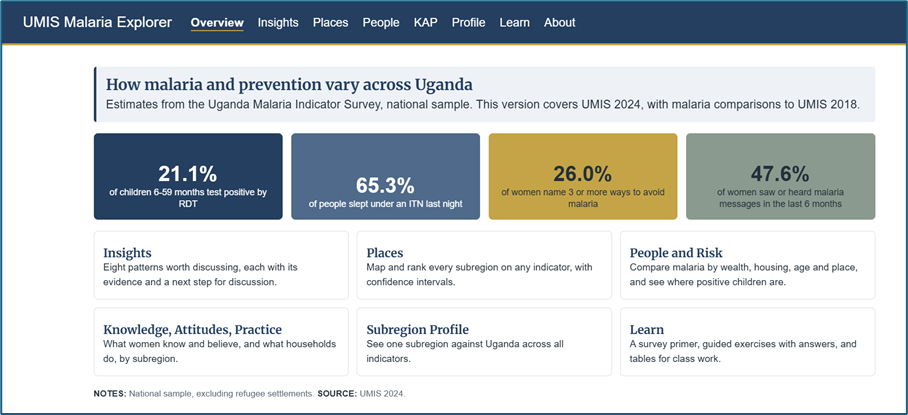
Click here for an interactive dashboard that lets you explore the 2024-25 Uganda Malaria Indicators Survey, where you can see demographic profiles, beliefs about malaria causes and prevention, and disease prevalence.